Harding Tracy (1775-1823)
Harding Tracy and Daniel O’Connell
In 1815 Daniel
O’Connell composed a speech regarding Napoleon achievements, his law system,
the state of justice in Ireland and of particular note that Judge Day was under
the influence of Dublin Castle. Some accounts state that it was delivered at a
‘purported’ meeting in Tralee but O’Connell later stated that it had been held
in Cork. O’Connell sent the manuscript of this speech to the ‘Mercantile
Chronicle’ in Cork for publication. When the speech was published, Mr. Saurin,
the Attorney-General was determined to prosecute and the only person he could
find liable was the registered printer, Mr. Harding Tracy. O’Connell could not
be convicted as the manuscript of the speech was destroyed, except for a part
of which that later became available. The paper was prosecuted and Tracy
pleaded guilty in court in Dublin, where O’Connell defended the case. Tracy
received a two year sentence, a fine of £300, and find security for the peace,
himself in £300 and two sureties for £200 each. Part of the sentence was later
remitted but he remained in gaol from May to December 1816. He contracted an
illness in prison, which stuck to him till his death. The Tracy family
maintained that he was totally neglected by O’Connell.
The following is a
report from the Belfast Newsletter of the 31st May 1816 of the
sentencing hearing:
Libel. Court of King's Bench Dublin, Saturday May 18.
The King v. Harding Tracy, Printer of the Cork Mercantile Chronicle.
This day the defendant was brought up to receive the sentence of the
Court, for having published a libel in his paper on 17th April 1815. To the
indictment the defendant pleaded guilty; and filed, in mitigation of
punishment, two affidavits. The first was the prisoners affidavit, which stated
in substances, "that he had no concern in the publication of the libel,
except that of being the registered printer of the paper; that he had never
read the publication said to contain the libel; that he had never seen the
original manuscript, or even a copy thereof, nor did he know what became of the
manuscript; that his health was very much impaired, and that he was advised by
physicians that protracted imprisonment would be destructive of his life; that
he was ready to make every atonement in his power to the law of his country,
and concluded by stating, that he had a life a wife and five children solely
dependent on his labour for subsistence, and that by his confinement they would
left destitute of support. The second affidavit was one made by Dr. Walsh. It
stated, that defendant was in bad health, and that confinement might be
productive of the loss of life...
[there follows about three columns of a report of the hearing ending
with]...The publication now stands as the speech attributed to Mr. O'Connell by
his client, which charge he (Mr. O'Connell) has not thought proper to deny. The
defendant had not stated, in his affidavit, his ignorance of the author; and
for this reason, as well as for these considerations already mentioned, the
Court did not think him entitled to any favour in the way of mitigation of
punishment; and that the sentence of the Court is, that he, Harding Tracy,
shall be imprisoned in the gaol of Newgate for two years, and pay a fine of
300l and that after the expiration of that imprisonment, to enter into a
recognizance to keep the peace, himself in 200l and two securities in 200l
each.
The Proceedings of
the Irish Catholic association of 1823-5, after the death of Harding Tracy,
give a rebuttal of the allegations against O’Connell.
The Dublin
Evening Post of the 11 February 1834 is a four page, five column, broadsheet. Four
column inches on page 2 and over 3/5th of the back page are given
over to the case of Harding Tracy and the “selfishness and treachery” of
O’Connell’s character.
1. There
is a synopsis of the affair.
2. There
follows an account printed in the Evening Mail shortly after Tracy’s
death. It states “Mr. O’Connell was counsel for the printer. He first
recommended the destruction of the manuscript (for fear of accidents) and then
advised him to plead guilty.” It further states that while in jail Tracy
received four pages of the manuscript of the speech from a fellow printer in
Cork which he could have used to his advantage and O’Connell’s disadvantage,
which he did not do. To the hour of his death, he never received a shilling,
nor have his family since, from O’Connell. It states that he was greatly indebted
for the help received from a fellow prisoner, the Roman Catholic barrister Mr.
Eneas McDonnell.
3. There
follows on an account from the Dublin Chronicle of the next day added
the following: That Tracy never received, nor his family, even his usual wages
during the period of his imprisonment. Even in Newgate, when he laboured for
the Dublin Chronicle, a journal patronised by Mr. O’Connell, was he
paid, nor his family. On his release, he was given a position with the Dublin
Chronicle until his death.
4. There
is a reply from Daniel O’Connell delivered at a meeting of the Catholic
Association on the 3rd July 1824 in which he lays out the charges
directed against him; a) That Tracy in possessing the manuscript had O’Connell
completely in his power but refused to use it. b) That Tracy had a bed of straw
in prison and was neglected. c) That Tracy’s family was left to starve. d) That
Tracy had got an illness in prison of which he died. There is a comprehensive
reply to the charges. He stated that Tracy did not plead and was eventually
released as a result of three affidavits stating that O’Connell was not
connected with the publication. O’Connell paid a half guinea a week for a good
bed and also got Mr. McDonnell to help him. He paid 32 to 40 shillings for his
board. During his imprisonment his wages at the Mercantile Chronicle was paid
to his wife every week. Tracy died seven years after being released from jail.
5. There
was a copy of a letter sent to the papers by Eliza Tracy the wife of Harding
Tracy. She stated that the report of the speech published stated that the
purported meeting was held on the 14th April 1815 in a south Parish
Chapel of Cork. The manuscript was copied by a living near relative of hers.
She states that her husband “Intoxicated by flattering promises, and led away
by wily persuasion, he was induced to leave his home and plead guilty to the
charge”. Her husband was sentenced on the 18th May 1816. Again, he
was seduced in believing that he would be liberated in a few weeks, his fines
paid, his family would be afforded every comfort. The promises were not kept
and his wages were stopped. She heard that her husband was dangerously ill, and
to ask friends for the money to travel to see him. He was in a bad state. Due
to the generosity of Mr. McDonnell until his removal. for the first four months
he had breakfast and dined with him. He paid for his own bed. His family in
Cork received only £3. In jail, he was employed as compositor for the ‘Dublin
Chronicle’, in combination with his son, for which he was still owed the bulk
of the wages. After his release, an application for aid from O’Connell for a
“few pounds”, was replied with two guineas, which is all the support that was
ever received from O’Connell.
6. There
was a statement from his son. He had an interview with Mr. McDonnell in
Kilmainham jail. Mr. McDonald said that O’Connell had pleaded poverty for not
having done something for your family and that £400 would not compensate the
family for the sacrifices they had made. He said that he had not contradicted
O’Connell’s account because they were in dispute and that it would have been
attributed to that circumstance. A letter addressed to Dr. Coyne, to rectify
the situation was given to the son including the sum of £10.
7. There
is a short paragraph stating that Dr. England, owner of the Cork Mercantile
Chronicle, had contradicted O’Connell’s account to Tracy’s friends.
8. It
is then stated that O’Connell had sent a letter of apology to a relative of
Judge Day.
9. There
is then an account of two letters sent by Harding Tracy to Mr. O’Connell. The
first received no reply and the second resulted in the messenger being abused.
10. It
concludes by stating that it was Judge Day’s intercession that secured Harding
Tracy release.
Fagan, in the main,
backs O’Connell account of events. He states that Harding Tracy was of strong
Tory connections. He names the person who found part of the manuscript as a Mr.
Higgins. He states that while in jail, Harding Tracy was employed as compositor
for the ‘Dublin Chronicle’ at a wage of over four pounds a week. In addition he
states that Harding Tracy son George Tracy, who was an apprentice there had his
wages raised. He states that O’Connell secretly aided Harding Tracy. In 1824,
after Harding Tracy’s death, the ‘Correspondent’ the paper that he and his son
George had worked on after his imprisonment, charged that O’Connell had allowed
him to pine in jail, of letting his family starve and of refusing him all
assistance when he was released from jail. His son, George, tried to establish
the case against O’Connell. Fagan goes on to state that Harding, on his return
to Cork, was catechised by his brother printers, and also stated that he had
nothing to complain about O’Connell at Mr. Haly’s own dinner table.
Keenan states that
Frederick Conway had a different impression of O’Connell’s conduct. Conway
recounted the affair of Harding Tracy in the Dublin Evening Post on 11 February 1834. That O’Connell
was not a bit worried if those who tried to assist him or took his legal advice
ended up in gaol. He always wanted to continue the legal struggle in their
behalf, regardless of the risks, they not he, ran. But on no account would he pay to get them
out of prison. This had happened with the editor of the Dublin Evening Post, John Magee in 1814, Harding Tracy the printer
in 1815, and Edward Hay in 1819. Conway, like the Earl of Donoughmore, was a
staunch anti-vetoist. It states that many other Catholics came to the same
conclusions about O’Connell at the same time.
In retrospect, it
may have been unwise of Harding Tracy to have engaged Daniel O’Connell as his
defence counsel, in circumstances where O’Connell was implicated but not on
trial.
Belfast
Newsletter 31 May 1816
Dublin Evening
Post, 11th February 1834 p.2 & 4
Fagan, William Trant (1847) The
Life and Times of Daniel O'Connell. O’Brien, Cork. Vol. 1, p.307-9
Freemans Journal 5 & 14 July 1824
Keenan, Desmond
(2002) The Grail of Catholic Emancipation
Proceedings in Dublin, May 13, 1823 to Feb. 11, 1825 -
Irish Catholic assoc - 1825 - 80 pages
Office of Chief Secretary of Ireland
28 Dec 1822-1 Jan
1823
Letter from police
magistrates, head police office, Dublin, to William Conyngham Plunket, Attorney
General of Ireland, 1 January 1823, enclosing copy of information of Robert
Kelly, sworn before Henry Charles Sirr, police magistrate; and also copy of
information of Standing [Harding] Tracy
of 15 Crow Street, Dublin, each concerning the identification of the origin of
printed slips, which were circulated during the riot at the New Theatre Royal,
Dublin, on 14 December 1822. Kelly refers to his involvement in printing some
of the slips, but states that he will not reveal 'the name of the person that
employed me'; also describes his view of an incident in which a bottle was
thrown at Richard Wellesley, 1st marquis Wellesley, Lord Lieutenant, inside the
theatre, 28 December 1821. Tracy states that the typeface of the printed slips
is not that used by any of the Dublin printing offices. Refers to a printed
slip entitled 'No Popery', and to another entitled 'The Protestants want
Talbot' [an allusion to former Lord Lieutenant of Ireland, Earl Talbot], 1
January 1823.
3 items; 9pp
CSO/RP/1823/1
9 Feb 1825-15 Feb
1825
Letter from Thomas
S Townshend [Townsend], Thornberry, [County Cork], to William H Gregory, Under
Secretary of Ireland, Dublin Castle, offering recommendation for Elizabeth Tracy, widow, as suitable
candidate to fill the post of house keeper to the War Office, [London].
Encloses letter from Thomas Townshend Sr, in support of Tracy and memorial from
Tracy to Gregory, expressing her interest in the post. Mentions having support
for her application from Captain Drought of County Limerick plus two members of
the Townshend family. Refers to the death of her husband, Harding Tracy, printer of the ‘Correspondent’ newspaper, from the
‘sufferings he endured from imprisonment &tc for a libel by [Daniel]
O'Connell’.
3 items; 7pp
CSO/RP/1825/33
Royal Irish
Academy
12 W 13 (120) Eliza
Tracy, July 1824
Newspaper clippings,
reporting on the imprisonment of Harding Tracy, editor of the Cork Mercantile
Chronicle for publishing a libelous speech [penned by Daniel O'Connell] against
the administration of justice and Judge [Robert] Day and O'Connell's apparent
lack of compassion and support towards Mrs. Tracy during her husband's
incarceration. With published copy of Mrs. Tracy's statement, written 19 July
1824 from Crow street, Dublin confirming her husband has been deceived by
"deceitful assurances" motivating him to plead guilty to the libel
charge and acknowledging the "kind assistance" of Judge Day is
securing an early release for her husband and arranging a private room for
Harding while interned in Newgate (Gaol).
12 W 13 (137) Eliza
Tracy, 20 February 1834, 22 February 1834.
Newspaper clippings,
reporting on the imprisonment of Harding Tracy, editor of the Cork Mercantile
Chronicle for publishing a libelous speech [penned by Daniel O'Connell] against
the administration of justice and Judge [Robert] Day and O'Connell's apparent
lack of compassion and support towards Mrs. Tracy during her husband's
incarceration. With published copy of Mrs. Tracy's statement, Dublin confirming
her husband had been mislead and as a consequence pleaded guilty to a libel
charge "a crime of another" and acknowledging the "kind
assistance" of Judge Day is securing an early release for her husband and
arranging a private room for Harding while interned in Newgate (Gaol). With
overview of an interview between Mr. Tracy’s son and [Eneas] MacDonnell
(McDonnell), a roommate of Tracy’s when interned at Newgate (Gaol).
Birth, Marriage and
Death Notices:
Harding Tracy (1775
Cork-1823 Dublin) m. Eliza Hurly (b. 1779) 1800 Cork (LDS)
Harding Tracy & Eliza Hurley 1800 (Marriage
Licence Bond)
May 29, 1823 Westmeath Journal - Death
On the 21st instant, at No. 15, Crow-street, Mr. Harding Tracy, many years
Printer of the Dublin Correspondent.
1831 Sophia [Anne?] Tracy and John Geary
(Marriage Licence)
May
24, 1831 (FJ) Marriages
In St. Mary's Church, on Sunday, the 15th
instant, by the Reverend Mr. Kelly, John Geary to Anne [Sophia] Tracy of
Capel-street, in this city.
October 11, 1852 (FJ) Death
September 18, was drowned,
while bathing in the Scioto river, Columbus, Ohio, United States of America,
John George, second son of John Geary, Esq, proprietor of The Capital City Fact
newspaper, and nephew of the Messrs. Tracy, 32 Lower Sackville street, in this
city, in the 17th year of his age.
July 11, 1857 (FJ) Marriage & 13 July
1857 Cork Examiner
June 17, at Fremont,
Ohio, United states, America, by the Rev. Mr. Bushuell, Richard Harding Geary,
Esq, eldest son of Colonel John Geary, late of this city, and grandson of the
late Harding Tracy, Esq, to Miss Fannie Haynes.
7
May 1862 (FJ) Battle of Pittsburgh
...lost their lives at Pittsburgh...Captain
Harding C. Geary, son of John Geary, of the Capital City Fact, Columbus...-
Cincinnati Inquirer (The gallant young officer above alluded to was the nephew
of the Messrs. Tracy, of 32, Sackville-street, in this city.)
4
May 1863 (FJ) Death
April 13, at Columbus, Ohio, U.S. America,
after a short illness, Sophia, wife
of Colonel John Geary, daughter of the late Mr. Harding Tracy, of Cork, and
sister of the Messrs. Tracy of Sackville-street, in this city. Her untimely
loss is deeply regretted by her sorrowing family and a large circle of friends
who knew her kindly disposition.
6 May 1863
Cork Examiner
... Harding Tracy,
of Cork, and sister of the Messrs. Tracy, of Sackville-street, Dublin.
Eliza
Tracy and William Mooney
1836 Marriage Licence
Eliza Mooney, died
30/9/40 Chapel Street, wife of William Mooney, dau of the late Mr. Harding
Tracy of Cork.
George R Tracy; Cork City COR>Dublin DUB IRL; Cork
Examiner (COR IRL); 1856-10-31; dja
1 November 1856 (N) Death. Tracey - Oct 29 at
32 Lower Sackville street, Mr. George R
Tracey, eldest son of the late Mr Harding Tracey of Cork.
October 30, 1856
(FJ) Death
October 29, at 32
Lower Sackville street, Mr. George R. Tracy, eldest son of the late Mr. Harding
Tracy of Cork.
31 October 1856 The
Cork Examiner,
Oct. 29, at 32,
Lower Sackville-street, Dublin, Mr. George R. Tracy, eldest son of the
late Mr. Harding Tracy, of Cork.
Mr. Richard Tracy
Richard Tracy,
Sackville-street, printer 1856 Intestate
Tracy - On the 21st
instant [February 1860], at his residence, 32 Lower Sackville street, Dublin, Mr. Richard Tracy, second son of the
late Harding Tracy, of Cork. He during life maintained a high ch??? for
unresisting prolity, and his loss will be deeply felt by his sorrowing
relations, and ??? circle of friends, who knew and appreciated his many kindly
qualities.
23 Feb 1860 (BL) Deaths
February 21, at his
residence, no.32 Lower Sackville Street, Dublin, Mr. Richard Tracy, second son
of the late Mr. Harding Tracy, of Cork.
24 February 1860 Cork Examiner
... Richard Tracy,
second son or the late Mr. Harding Tracy, of this city.
1860 The Phoenix NY
Richard Tracy, 82 Lower
Sackville St, Dublin, died.
Harding Charles Tracy
1
November 1865 (FJ) & 4 November 1865 (N) Deaths
Tracey - October 5, in Columbus, Ohio, United
States America, Harding Charles Tracey, Esq., formerly of 32 Sackville-street,
Lower, youngest son of the late Harding Tracy, Esq, of Cork, deeply and sadly
lamented by his sorrowing family and friends. His remains were interred in
Greelawn Cemetery, about two miles from the city.
2
November 1865 Cork Examiner
Harding Charles
Tracy, Esq., formerly of 32, Sackville-street,
Lower, Dublin, youngest son of the late Harding Tracy, Esq., of Cork. October
5, in Columbus, Ohio, United States America,
James
Tracy
James Tracey died 1869, Dublin North PLU, Aged 48, b.
1821, died 6 May 1869 [James Tracy, 50, Sackville St. No.32 Lr. buried 8 May
1869 Mount Jerome Cemetery]
James Tracy
d. 6 May 1869 32 Lower Sackville Street Dublin, gentleman bachelor,
died Richmond Lunatic Asylum, to sister and only kin, Harriett Tracy, spinster
James Tracy
d. 6 May 1869 Dublin 32 Lower Sackville Street Dublin, gentleman
bachelor, died Richmond Lunatic Asylum, unadministered by sister Harriett
Tracy, ...attorney of a nephew
22 May 1869 (FJ) Death
May 20, after a lingering illness, Mr. James Tracy, of the firm of Tracy,
Brothers, 32 Lower Sackville-street, fondly beloved and deeply regretted by his
sorrowing sister.
Harriet
Tracy
February
27, 1892 News from Ireland
Tracy - At 33 Lower O'Connell street, January
29, Harriet Tracy, aged 80? years.
No 153 Mills & ors to Tracey
11 Mar 1868 between Mary Mills of Prince Edward Terrace Blackrock in the County of Dublin widow of Lewes Wills deceased of the one part Townsend Mills gentleman Susan Mills Spinster of same place and Louis Mills of Grosvenor Squar Rathmines in the said County Gentleman Said Townsend Mills Susan Mills and Louis Mills being the children and only next of Kin of said Lewis Mills deceased of the second third and fourth parts and Harriett Tracey of Sackville Street in the city of Dublin Spinster of the fifth part...the sum of Two hundred and eighty pounds paid by the said Harriett Tracey...confirm to the said Harriett Tracey such assignment bargain and sale of all that and those the lot of ground containing forty feet in front to the road leading from Blackrock in the County of Dublin to Newtown Park...
No 245 Crowe and ors to Trevor
28 Sep 1868 between George Crowe of Beechhill in the County of Dublin Esquire of the first part Harriett Tracey of Sackville Street in the City of Dublin Spinster of the second part Mary Mills of Blackrock in the County of Dublin widow and adminishix men of Lewis Mills of deceased of the third part Townsend Mills of Blackrock aforesaid Gentleman Susanne Mills of Blackrock in said County of Dublin Spinster and Louis Mills of Rathmines in said County of Dublin Gentleman , which said Townsend Mills , Susanne Mills and Louis Mills are the children and only next of kin of the said Lewis Mills deceased ) of the fourth part and Samuel Trevor of St Cloud Golden Ball in the said County of Dublin Esquire of the fifth part...to said Harriett Tracy to secure repayment of the respective sums of Two hundred and fifty pounds and two hundred and eighty pounds with interest , and that said Samuel Trevor had agreed to pay off said Mortgages...
1809 Report of the Pipe Water Commissions, Cork
City
Harding
Tracey, Half Moon St., £36/0/0
1814-5 Finance Accounts
Arrears of Advertisment Duty due by Printers of Newspapers in the
Country
Tracey, Mercantile Chronicle, £52 [Cork?]
17 December 1816 (FJ) Provincial Intelligence
Cork, Dec.
14. Mr. Harding Tracy, late Printer of the Cork Mercantile Chronicle, has been
liberated from imprisonment.
1818 (147) The finance accounts
Arrears of
Newspapers, Messrs Tracy, Cork M. Chronicle, £30.2.6
1819 The finance
accounts
Arrears due by Printers of Newspapers in the Country...Tracey, Cork Mer. Chronicle, £27...
|
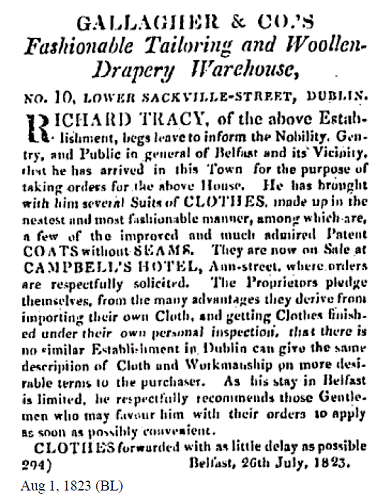
1823 (BL) Gallagher
& Co, No.10 Lower Sackville Street Dublin Richard Tracy of the above establishment...Belfast [see advertisement opposite] 1824 The finance
accounts Arrear due by printers in Dublin...G.R. Tracey, Correspondent, £56.6.10 farthing 1825 & 1826 Commissioners for Auditing Public Accounts in
Ireland Stamp Duty - Arrears due by Printers of Newspapers in Dublin "Correspondent", G.R. Tracey, £61/0/9 & £70/18/5.5
1826-1827 Dublin Directory Richard Tracy, merchant tailor, 30
Capel St December 15, 1841 (FJ) Letter Mr. George Tracy,
sub-editor of the Evening Packet [1828?] July 15, 1829 to June 19, 1856 (FJ) Market and Grand Jury Dublin ...Richard
Tracy... January 23, 1830
(FJ) Dublin Corporation - Quarter Assembly Mr. M'Cleery moved that the board be requested to re-consider the resolution, refusing the freedom to Mr. Tracy, a respectable merchant tailor, and the son of Mr. Harding Tracy, who, as they were all aware, fell a victim to designing demagogues, and was literally murdered in Newgate (hear). The motion having been seconded, passed unanimously. [Freedom of the City] 1830 Valuation of the City of Dublin - Parish of St. Andrew 15 Crowe-street, Tracey, value £32/10/0, 14th class, £0/9/2.75
Minister's money, 3 stories small rere. 1830-1836 Dublin Directory Richard Tracy, merchant tailor, 38
Capel St 1837 Fictitious Votes - City of Dublin
G. Richard Treacy, freeman, Christmas 1835, 5 March 1835 George R. Tracey, £1, service, merchant admitted to Freedom of
Guilds 12 January 1835 George Richard Tracy, 38 Capel-street, merchant, freeman, 23/30
May & 2 June 1835 Richard Tracey, claim by grace, passed 5 Oct 1829 p.166, sworn
11 June 1830 - Corporation of Tailors Richard Tracy 30 October 1832 Richard Tracy, 38 Capel-street, clothier, leaseholder, £10, 11
Aug 1835 1837-1839 Dublin Directory Richard & J Tracy, mens
mercers, 70 Dame St 20 July 1838 (FJ) Liverpool July Meeting ...Irish sporting friends to cross the channel...G. and R. Tracy... 1840-1843
Dublin Directory R & J Tracy, mens mercers, 32 Lr Sackville St 1841-1843
Dublin Directory George & Harding Tracy, general printing office, 32 Lr Sackville St R & J Tracy, mens mercers, 32 Lr Sackville St 8 June 1842 (NG) Present State of Tipperary. As regards agrarian outrages - their nature origin, and increase, considered - with suggestions for remedial measures, respectfully submitted to the Right Hon. Lord Elliot M.P. by a magistrate of the county. - Dublin:- G. R. Tracy - Price one shilling. 10 May 1843 (CE)
Shipping? ...G. R. Tracy, 32, Lr. Sackville-street. Dublin, and sold by... October 3, 1842 (FJ) ...printers for
the corporation...Tracy... 1844-
Dublin Directory Brothers Tracy, printers & men’s mercers, 32 Sackville St lower 4 January
1844 Freeman's Journal
The
special jury panel for 1844 as delivered by David Charles LaTouche, Esq, AB
High Sheriff of Dublin this evening Richard Tracey, 32 Lower Sackville street, merchant tailor 1848-51 Griffiths Valuation Dublin
Brothers Tracey, 32 Sackville Street Lower
St. Thomas Dublin |
|
Endowed School of the Corporation of
Tailors, or Guild of St. John the Baptist
In 1840, when the
Municipal Corporations Bill was pending, a return as to the Gild property was
made, and on its passing it was resolved that the Gild's estate should be
vested in trustees, members of the churches of England and Scotland, for the
religious and general education of children of freemen of the Gild and other
freemen of the city. Twelve trustees were appointed, three of whom were to hold
the keys of the archives. They were Richard Tracy, William Mooney, David
McCleery, Thomas J. Quinton, Allan Ellison, Wm. Roberts, James McMullen, George
Macdona, Robert Singleton, John Whitty, Rev. Alex. Deeper, Charles Brien, Rev.
T. D. Gregg (added), Robert Jackson, treasurer, Lewis de Zouche, secretary. On
9th April, 1841, a Deed conveying the Gild property to the above-named trustees
was executed... On the abolition of the gilds in 1841, the Hall passed
into the hands of the Trustees of the Tailors' Endowed School, which was
transferred in 1873 to the Merchants' Hall, Wellington Quay...In 1840-1 Richard
Tracy was Master of the guild...
Henry F. Berry (1918) The Merchant Tailors' Gild: That
of St John the Baptist, Dublin, 1418-1841. The Journal of the Royal Society of
Antiquaries of Ireland, Sixth Series, Vol. 8, No. 1 (Jun. 30, 1918), pp. 19-64
1
July 1840 Wexford Conservative
The Corporation - Guild of St. John. A
meeting of the ancient and truly-loyal Corporation of Tailors was held on
Wednesday at the Guild Hall for the purpose of swearing in the Master and
Wardens for the ensuing year. The new officers are - Mr. Ricahard Tracy of
Sackville street, Master...Masters Dinner. Mr. R. Tracy, the newly elected Master,
entertained the Brethren and numerous guests at dinner at Judes's Hotel in the
evening...
6
Jan 1896 (BL) Winter Ehibittion at the Royal Academy
...large silver tankard...made in Dublin in
1680 for the Guide of Merchant Tailors...on the handle..."Repaired A.D.
1841. Richard Tracy Master Wm Mooney Warden John Jones S."
February
14, 1848 (FJ) Houses and Lands
The Trustees of the school and Charities
established by the Guild of St. John, hereby give Notice, that the Lease of the
property comprising of the Houses respectively numbered
129, 130, 131, 132 in Church street
28, 29 and 30 Bow street
and the entire of the houses and Premises now
standing on both sides of Bedford street in the City of Dublin
will expire on the 25th day of March 1848.
Persons desirous to become tenants for same, or any part thereof, are invited
to send in their proposals, addressed to the Treasurer, Mr. Richard Tracy, No.
32 Lower Sackville street, Dublin before the 1st day of March. Dated this 10th
day of February 1848.
February 1860 (IT) Endowed School of the Corporation of Tailors, or
Guild of St. John the Baptist, Back-Lane, Dublin
Wanted for the above school, a
fully qualified Protestant Master. The course of instruction embraces
Mathematics and a complete English and Mercantile Education, together with the
rudiments of the Greek and Latin Classics. A Graduate of T.C.D. and one having
a wife or female relative who must reside on the premises, will receive a
decided preference. It is particularly requested that no gentleman will apply
who is attending or will thereafter attend, Divinity Lectures, or who cannot
give unquestionable proofs of his moral and religious character as well as his
scholastic attainments. Applications with copies of testimonials must be sent
to the Trustees, care of the Treasurer, Richard Tracy, Esq., 32 Lower
Sackville-street, Dublin, before the 26th inst. The gentleman
appointed would be required to enter on his duties early in March.
September 1862 Endowed School of the Corporation of Tailors, or Guild
of St. John the Baptist
The trustees of this excellent
school, founded by the late Richard Tracy, Esq., of 32, Lower Sackville-street,
in the year 1841, met at their board-room, Back-lane yesterday. After the general
business was over, Mr. James Tracy, in a short but pithy speech, on the
Classical Education in Schools in general, and in particular the Irish
Language, proposed to pay an Irish teacher out of his own pocket, and likewise
to furnish a short-hand writer to instruct the boys. The meeting then
adjourned.
1850 Thoms Directory of
Ireland
Tracy Brothers, 32 Sackville Street Lower, woollen drapers, merchant tailors, hosiers, etc
1850 Shaw's Dublin City Directory
Tracy Brothers, 32 Sackville St Lower (woollen drapers)
1851 Census
Rich Tracey, 32 Sackville St Lr, Dublin City
The Racing Calendar for the Year 1851 by Robert J. Hunter,…Printed for the Proprietor by: George R. Tracy, 32, Sackville-Street And sold at the Publisher’s Office, No.1, North Cumberland-Street; ...1852
March 5, 1850 (FJ) Sporting -
Tallaght Steeple Chases
...Judge, Mr. G. Tracy...
April 6, 1850 (FJ) Sporting -
Dollymount Races
...Judge, Mr. G. Tracy...
May 27, 1850 (FJ) Sporting -
Sandymount Races
...Judge, Mr. G. Tracy...
October 8, 1850 (FJ) Irish
Metropolitan Steeple-chases
Subscribers...G R Tracy...
December 26, 1850 (FJ) Tallaght
Steeple Chases
The stewards, in order to prevent deception have directed Mr. G. Tracy,
the authorised printer, to publish the cards of these races.
March 10, 1851 (FJ) Kilcock
Steeple Chases
The only genuine cards of the races are published by G.R. Tracy
December 11, 1851 (FJ) Confy
Castle Steeple Chase
The Tracy Stakes - Hanicap Sweepstakes, 5 sovs each, 1 sov
enterence, 50 sovs added by George R. Tracy, Esq., Dublin, Printer to the Turf
Club. Three miles over Confy Castle course.
March 24, 1852 (FJ) Palmerstown
Hunt Steeple Chases
All information respecting these races to be obtained from Mr. G.R.
Tracy, at the Metropolitan Sporting
Printing Office, 32, Lower Sackville-street, Dublin.
1852 The Racing Calendar for the Year 1851
by Robert J. Hunter,…Printed
for the Proprietor by: George R. Tracy,
32, Sackville-Street
October 4, 1854 (FJ) Citizens
Gold Challenge Cup
...Mr. GR Tracey handed in from a worthy citizen, Mr. Wm Egan, grocer,
Summerhill, half a sovereign (hear, hear)...
The Racing Calendar for the Year 1854
by Hunter, Robert J.
Printers: Treacy, Dublin
September 18, 1852 (FJ) The late Fire in
Dawson street
...donations
received...Mr. George R. Tracy, Sackville street £1; Mr. Richard Tracy, do, £1;
Mr. James Tracy, do, £1;...
August 25, 1855 (FJ) Dublin Citizens' Gold
Cup
Subscriptions were
handed in:- Messrs GR Tracy and - Tracy, Brothers, Sackville street £1 each;...
1856
Richard Tracy, Sackvill Street, Printer (Intestacy) [??? George See obituary]
January 19, 1857 (FJ) One Pound Reward
Lost on Friday
evening last, between the railway station at Salt Hill and the Antient Concerts
Hall, great Brunswick-street, an Antique gold bracelelet, set with five pink
topizes. Whoever will return it to Mr. Tracy, 32 Lower Sackville street, will
receive one pound reward. 17th January 1857.
June 18, 1857 (FJ) The Gas Question
...Richard Tracy, 32
Lower Sackville street...
September 12, 1857 (FJ) Gold Watch Lost
Yesterday afternoon
(Friday) supposed in a shop in Grafton street, a Lady's Gold Geneva Watch
(Stauffor, Geneva, Makor) attached to a drop chain with a bunch of charms, gold
dial and spider hands. A reward of one pound will be given on restoration to
Mr. Tracy, 32 Lower Sackville street. Saturday 12th September 1847.
10 August 1861 (FJ) Four Courts
George Miller, detained at the
suit of Harriet Tracey and James Tracey, a lunatic, by his next friend, the
said Harriet Tracey.
9 December 1861 (FJ) Court of
Common Pleas - George Miller v. Harriet Tracey
This was an action for malicious
arrest of the plaintiff on a judge’s fiat. The defense was a plea of
justification. It appeared that the plaintiff had been an assistant in the
establishment of Messrs. Cannock, White and Co. And that he agreed to take a
shop and premises in Sackville street, at a tearly rent of £117. He accordingly
lodged with Mr. Bergin, solicitor, the sum of £58, two quarters rent in
advance, and sold goods to the brother of the defendant of the third quarter
rent. He was subsequently arrested on a judges fiat, which had been obtained on
the authority of a statement made by a shop-woman in his employment that he was
going to America. An application was subsequently, made to Mr. Justice Hayes
for his discharge, and it being shown that the statement was unfounded, he was
accordingly discharged. The action was brought for this alleged malicious
arrest.
9/10 December 1861 George Miller V. Harriette Tracy
This was an action to recover
damages, laid at £1000 for false imprisonment. The plaintiff became the tenant
of the defendant for the shop and part of the house 32, Lower Sackville-street,
at an annual rent of £117, payable quarterly, when he commenced business as a
draper. A fire broke out in the house some time afterwards, after which the
plaintiff did not carry on business. The defendant caused him to be arrested on
the 7th of August last for a sum of £72/15/0, the balance of rent which she
alleged to be due, and he was detained in custody until the October following.
The plaintiff alleged that the arrest was made maliciously, and that the amount
claimed for rent was not due by him, as he had supplied goods to a large amount
to the brother of the defendant, who owned one half of the house. She pleaded
that her brother was not of sound mind, that the plaintiff was aware of this,
and that she had warned him not to give any goods to her brother. She also
stated that the Plaintiff had disposed of his property and intended to
immigrate. The jury found for the defendant.
1862 Thom’s
Dublin Street Directory
Harriett Tracy, Miss, (90l). 32 Sackville-street,
Upper.
James Tracy, esq, 32 Sackville
street lower
August 1862 The Freeman Franchise
Sir, Having been a registered
Freeman of this city since the year 1840[?], and having since then
uninterruptedly exercised the Parliamentary franchise, I was very much
astonished at finding that a notice of objection had been left at my house, and
purporting to bear signatures of Matthew McKeon, of 34 Montgomery street, I
went to that address, and a notice of removal being posted thereon, I enquired,
and was told that no person of that name resided there. I have for many years
been a resident in Sackville street, and have acted as treasurer of the
"North Dock Ward Protestant Club" and displaced many Radical
Franchise seekers, which fact may perhaps account for the petty malignity
displayed by a person totally unknown to me, and who shields himself under a
false address, and for all that I know, under a false name.
I am sir, your obedient servant.
James Tracy, 32 Lower Sackville street.
7 July 1870 (FJ) Jervis street Hospitals
...1s...Miss Tracy, Sackville
street...
Jul 1870 Jervis Street Hospital
...donations...Miss Tracy,
Sackville street...
Last update: 15
May 2025